
9-Meter Mountains of Sargassum: A Growing Environmental and Public Health Concern in the French Caribbean
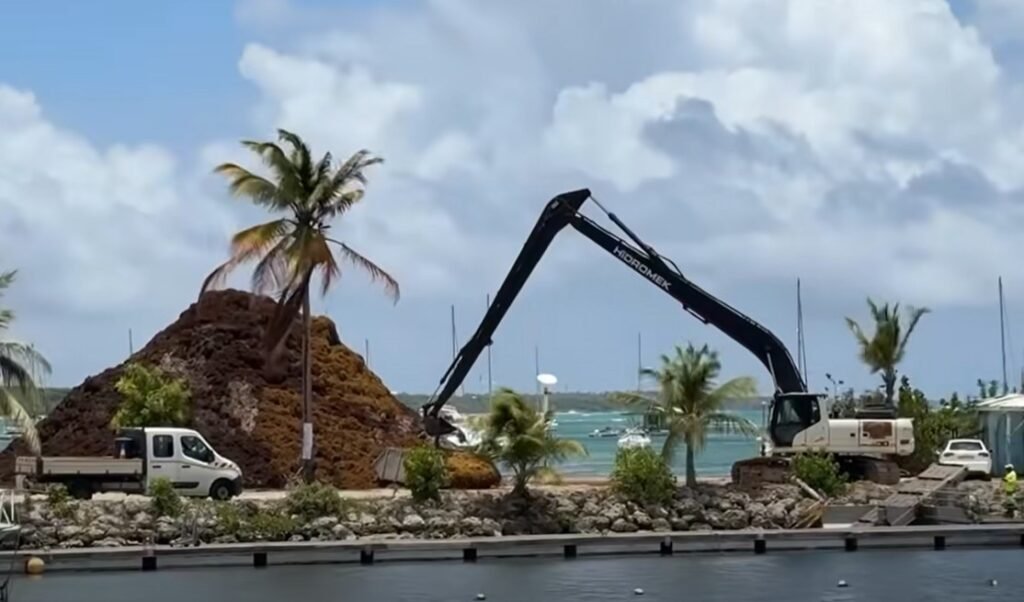
In several French Caribbean islands, massive piles of decomposing sargassum are now reaching heights of up to 9 meters.
These are no longer simple algae accumulations along the shoreline.
They resemble mountains.
🎥 Videos and field images show heavy machinery removing enormous quantities of sargassum from the sea and stacking them near beaches, roads, and inhabited areas. Excavators, cranes and backhoes are now part of the daily landscape in some affected zones.
But as these piles remain exposed for days under tropical heat, concerns are rapidly growing among residents and observers.
When sargassum decomposes, it releases gases such as hydrogen sulfide and ammonia. Residents frequently report unbearable odors, headaches, nausea, eye irritation and respiratory discomfort near decomposition sites.
Environmental and health specialists have repeatedly warned that prolonged accumulation of rotting sargassum near populated areas can create serious environmental and public health issues. Rapid treatment and controlled management are generally recommended — not the creation of giant decomposing storage piles several meters high.
Across the French Caribbean, many inhabitants are now questioning whether emergency management is slowly turning into a secondary environmental crisis.
The images are striking:
👉 mountains of brown algae,
👉 construction machinery operating continuously,
👉 and entire sections of coastline transformed into temporary dumping zones.
Removing sargassum from the sea is necessary.
But what happens afterward is becoming one of the biggest challenges of the entire crisis.
As sargassum influxes continue increasing across the Atlantic and Caribbean region, the question is no longer only how to remove the algae from beaches — but how to manage the enormous volumes safely, rapidly and sustainably.
The scale of the phenomenon is growing.
And so are the questions surrounding its management.
🌍 Since 2018, Sargassum Monitoring has documented sargassum arrivals across 44 impacted countries through geolocated field reports, satellite observations and daily monitoring.
👉 Consult the live map
👉 Send your photos and reports
👉 Help document the crisis
You’re not just here to watch.
You’re now part of the solution.