
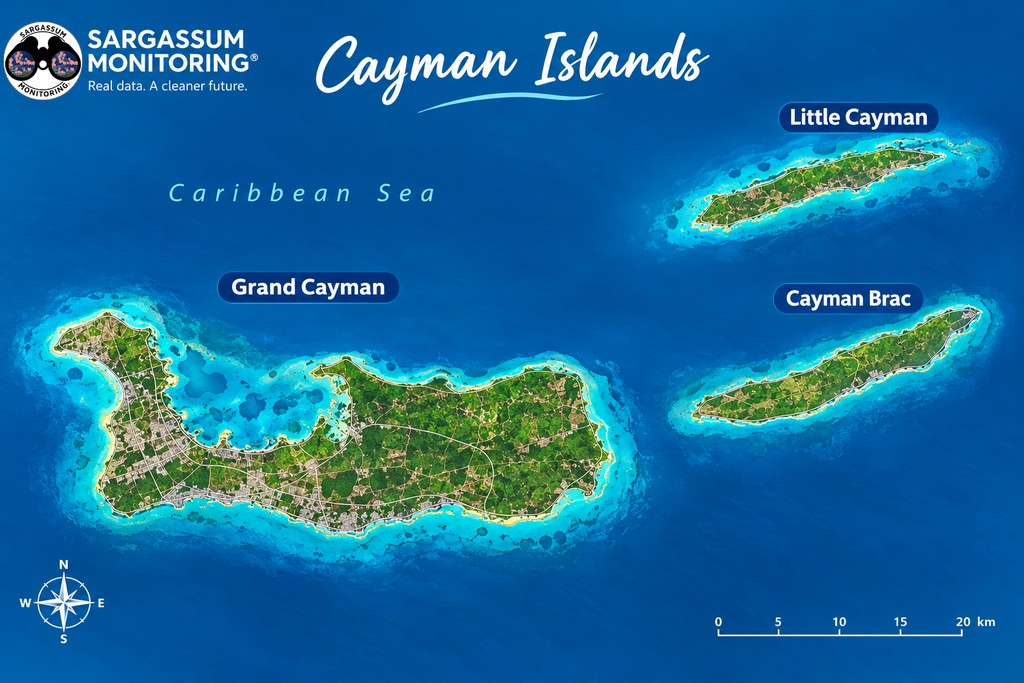
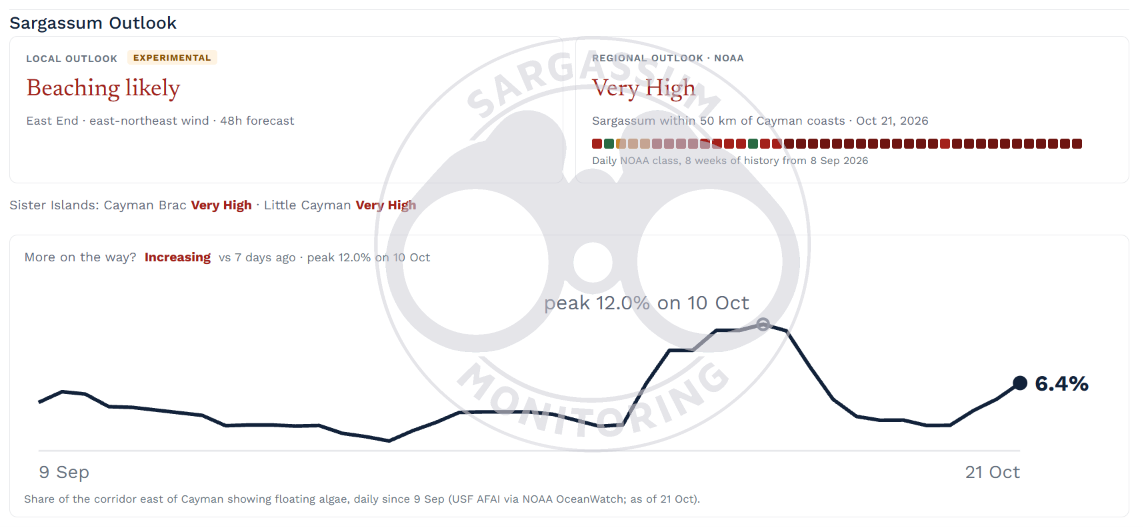
A daily early-warning outlook for sargassum seaweed near the Cayman Islands, from NOAA’s Sargassum Inundation Risk product.
This tracks floating seaweed offshore, not a live beach report.
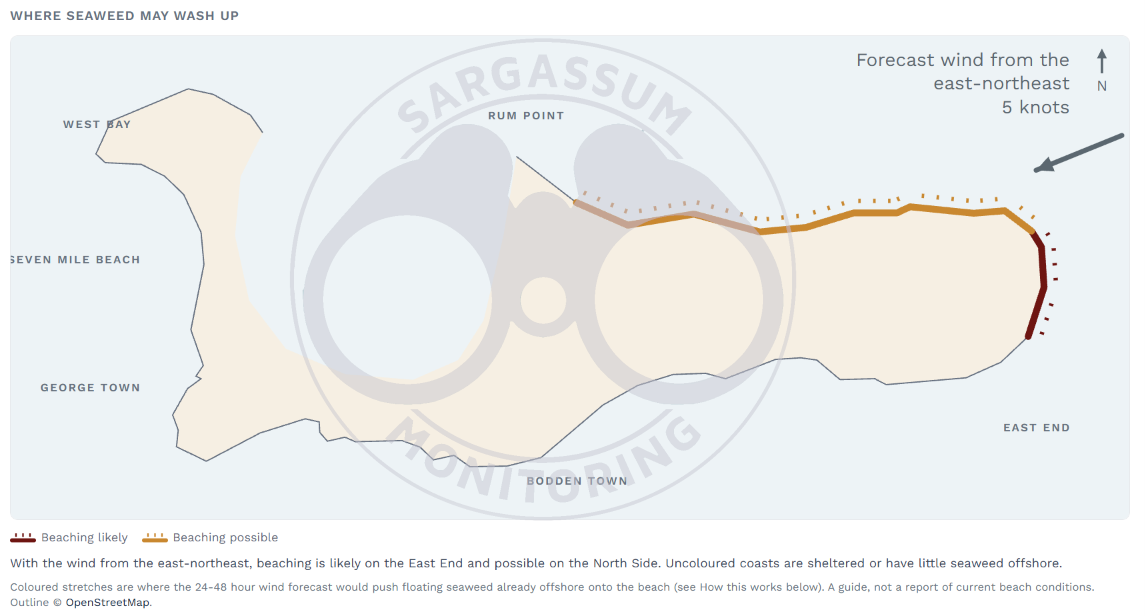
West-facing Seven Mile Beach is usually spared; the south and east coasts beach first.

Updated on October 22, 2026
About Sargassum in Cayman:
Sargassum season in the Cayman Islands typically runs April through October, with peak accumulation between May and August. East End and South Side are usually the first and most heavily affected coastlines, while Seven Mile Beach on the leeward west side sees less impact.
According to the University of South Florida’s Optical Oceanography Lab, 2026 is forecast to be a record sargassum year for the Caribbean, with satellite observations showing record open-ocean biomass since early spring. USF publishes a monthly outlook bulletin with a two-month projection for the region.
Regional outlook. NOAA’s Sargassum Inundation Risk product measures floating sargassum detected by satellite within about 50 km of each stretch of coast, updated daily. It says how much seaweed is near the island, not whether any is on a beach.
More on the way? (upstream supply). Sargassum drifts westward on the Caribbean Current, so the floating-algae signal in the satellite corridor east of Cayman today (USF AFAI fields via NOAA OceanWatch) is roughly the supply arriving over the next one to two weeks. The strip reports what share of that corridor shows algae and whether it is rising or falling against last week.
Local outlook. A Daily.ky rule of thumb, not a NOAA product: when offshore levels are high, coasts that face into the wind (within about 60 degrees) are marked as likely to receive seaweed, because floating mats drift with the wind near shore. It is driven by the 24-to-48-hour wind forecast (Open-Meteo, speed-weighted), so it looks a day or two ahead; it applies to the open coast only (the enclosed North Sound and canal systems receive no offshore supply), and is an educated guide, not a verified forecast.